
Reports module
The Reports module provides statistics about the items and activities recorded in Trail. You can use the reports to get an overview of item quantities, reservations, maintenance, and future investment needs.
Reports are based on information stored in Trail, so the content and accuracy of the reports depend on the information recorded for items and activities.
Depending on your organisation's settings and enabled features, different reports may be available in the Reports module. These can include:
- Departments and categories
- Investments
- Reservations
- Maintenances
- Model MTBF
- Lendings
- Storage status
This article explains the different report views and the information they provide.
Departments and categories
The Departments and categories report provides an overview of your organisation's items by department. You can use the report to review item quantities, condition ratings, missing information, and the total purchase price of items.
The report shows the following information for each department:
- Categories: Categories linked to the department.
- Marked: Number of items that have been marked with a label or have a My identifier value.
- Available: Number of available items that have not been read out to a reservation.
- Items: Total number of items in the department.
- Missing info: Number of items missing at least one of the following: renewal price, estimated lifespan, or purchase date.
- Condition (stars): Distribution of items between different condition ratings.
- Total price: Total purchase price of the items in the department.
Click a department name to view the information in more detail:
Department → categories → category models → model items
This allows you to see, for example, which categories and models make up the item quantities and total value of a department.

Investments
The Investments report helps you estimate your organisation's future item renewal needs. Trail automatically calculates an estimate for the next ten years.
The estimate is based on the following information recorded for items:
- purchase date
- estimated renewal price
- estimated lifespan
An item must have all of these details to be included in the calculation. If any of the information is missing, the item is not included in the investment estimate.
The Outstanding column shows the total estimated renewal price of items that have exceeded their estimated lifespan but have not yet been added to an investment plan.
When an item is added to an investment plan, it is removed from this report. The report therefore shows potential future investments that have not yet been included in an investment plan.
To learn more about investment planning, see: Investments

Reservations
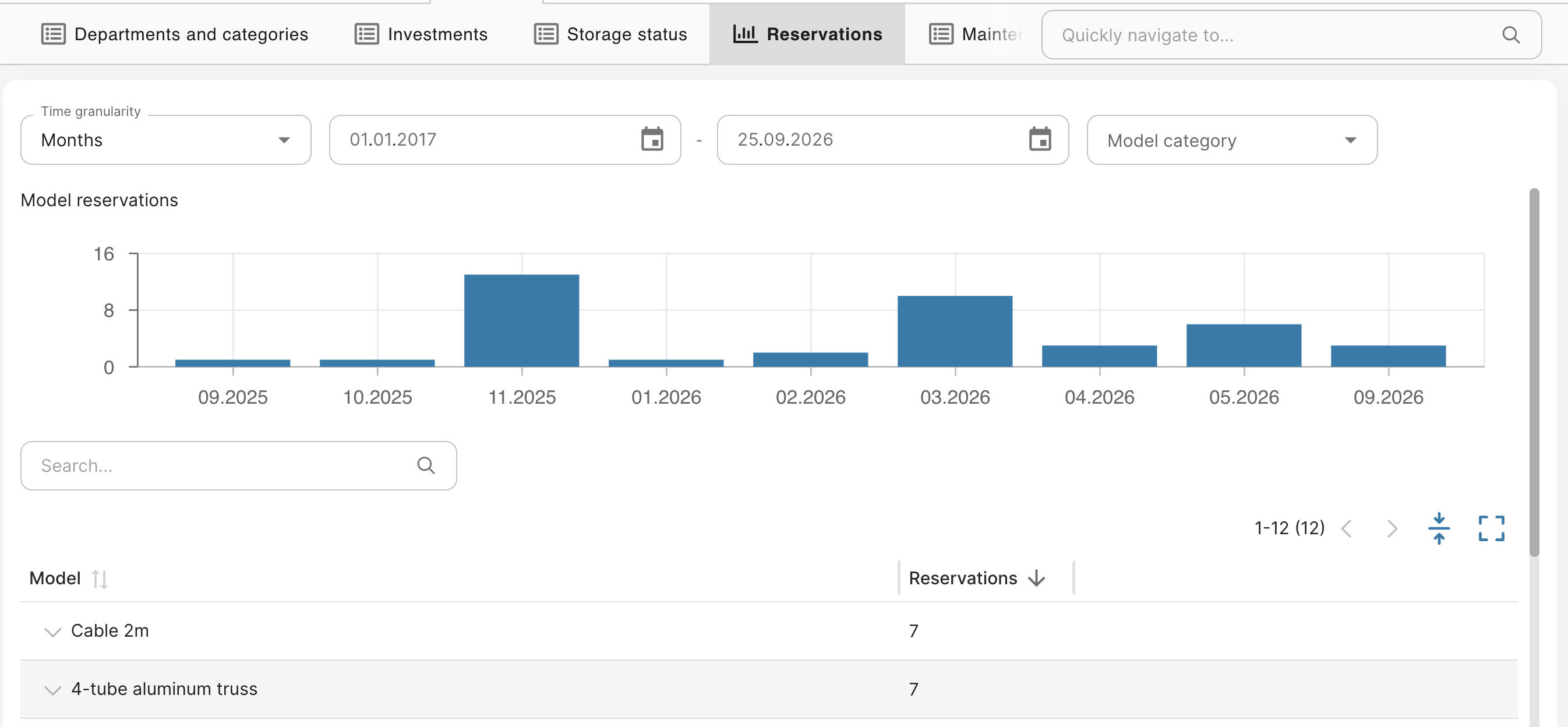
The Reservations report allows you to review how items have been used in reservations.
The report shows on a weekly or monthly level how many items of each model have been read out to reservations. The information can be viewed as a bar chart or a model-specific list.
You can use the report, for example, to compare the use of different models and see how many items have been used in reservations during a selected period.
Maintenances
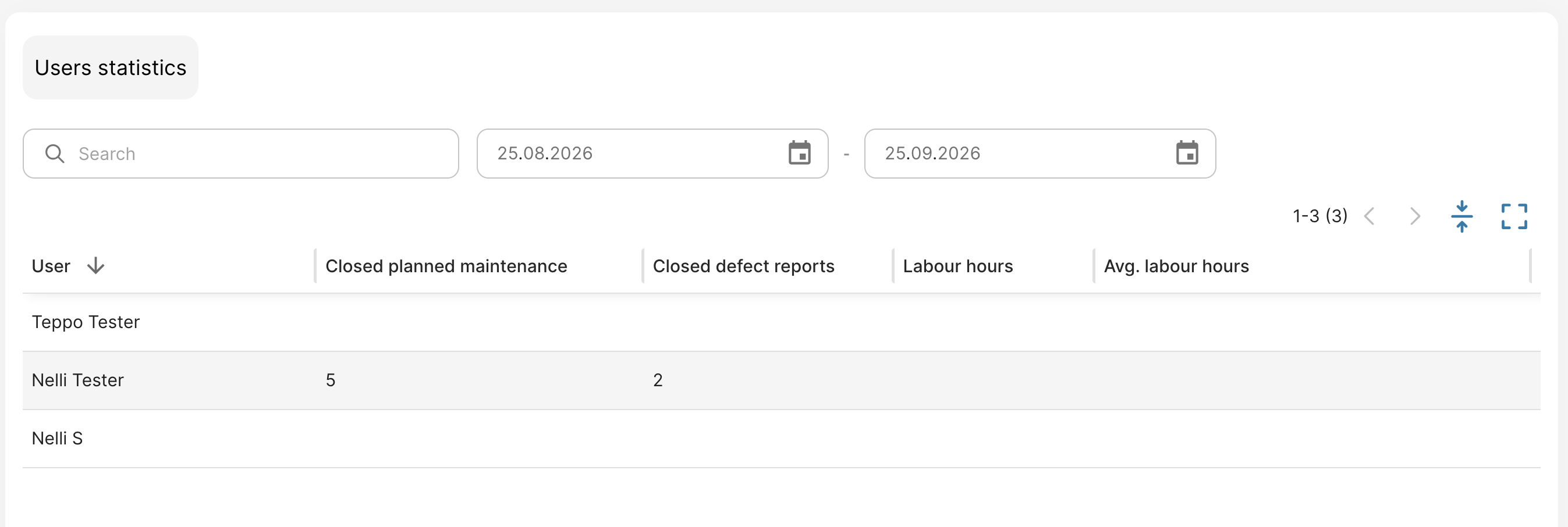
The Maintenances report provides an overview of maintenance work completed by users.
The report shows the following information by user:
- number of closed defect reports
- number of closed scheduled maintenances
- time spent on maintenance (labour hours)
- average time spent on maintenance
Time information is shown when the time spent on maintenance has been recorded in Trail.
You can filter the results by date range and search for a specific user by name. This allows you to review, for example, maintenance work completed by a particular user during a selected period.
Model MTBF
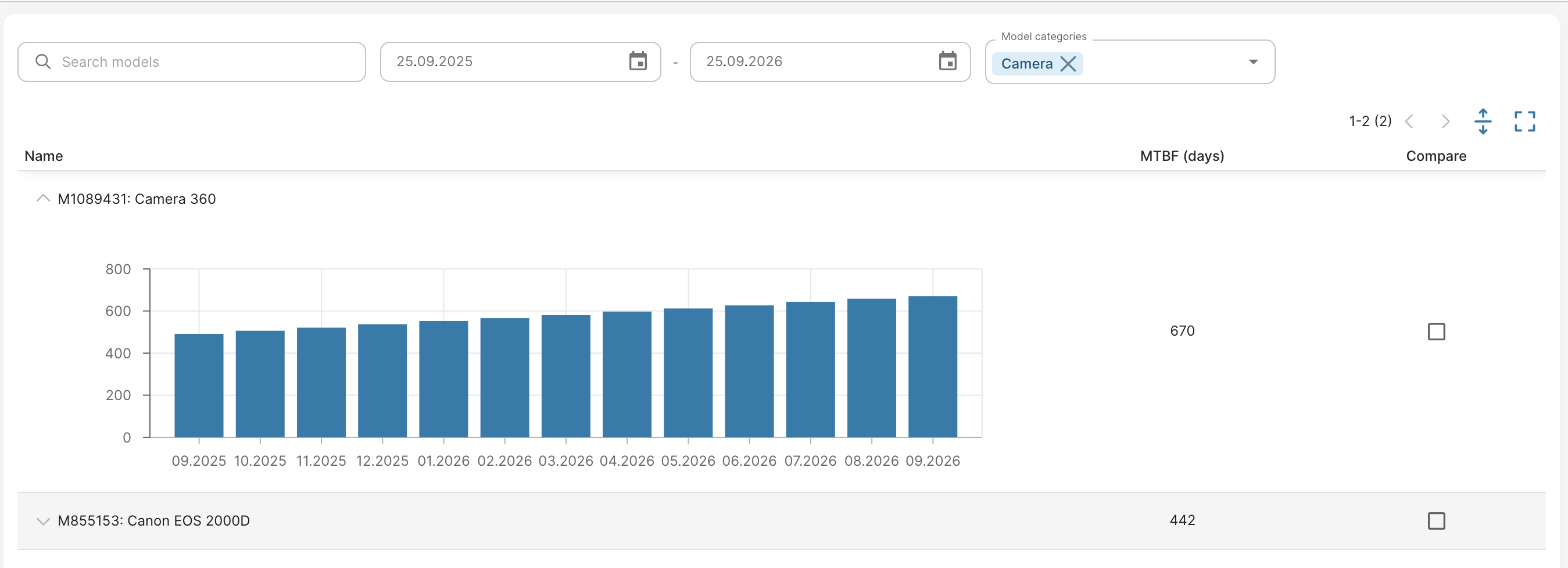
Trail can be used to track MTBF (Mean Time Between Failures). MTBF describes the average operating time between equipment failures.
The Model MTBF report allows you to review MTBF values by item model. The calculation is based on the lifecycle operating hours and approved defect reports of the items belonging to the model.
The model MTBF is calculated by dividing the average total lifecycle operating hours of the model's items by the number of approved defect reports.
An item-specific MTBF value can also be displayed on the item card. The item-specific value is based on the item's lifecycle and its approved defect reports.
MTBF information can be used, for example, to review how frequently items of a particular model experience failures.
Lendings
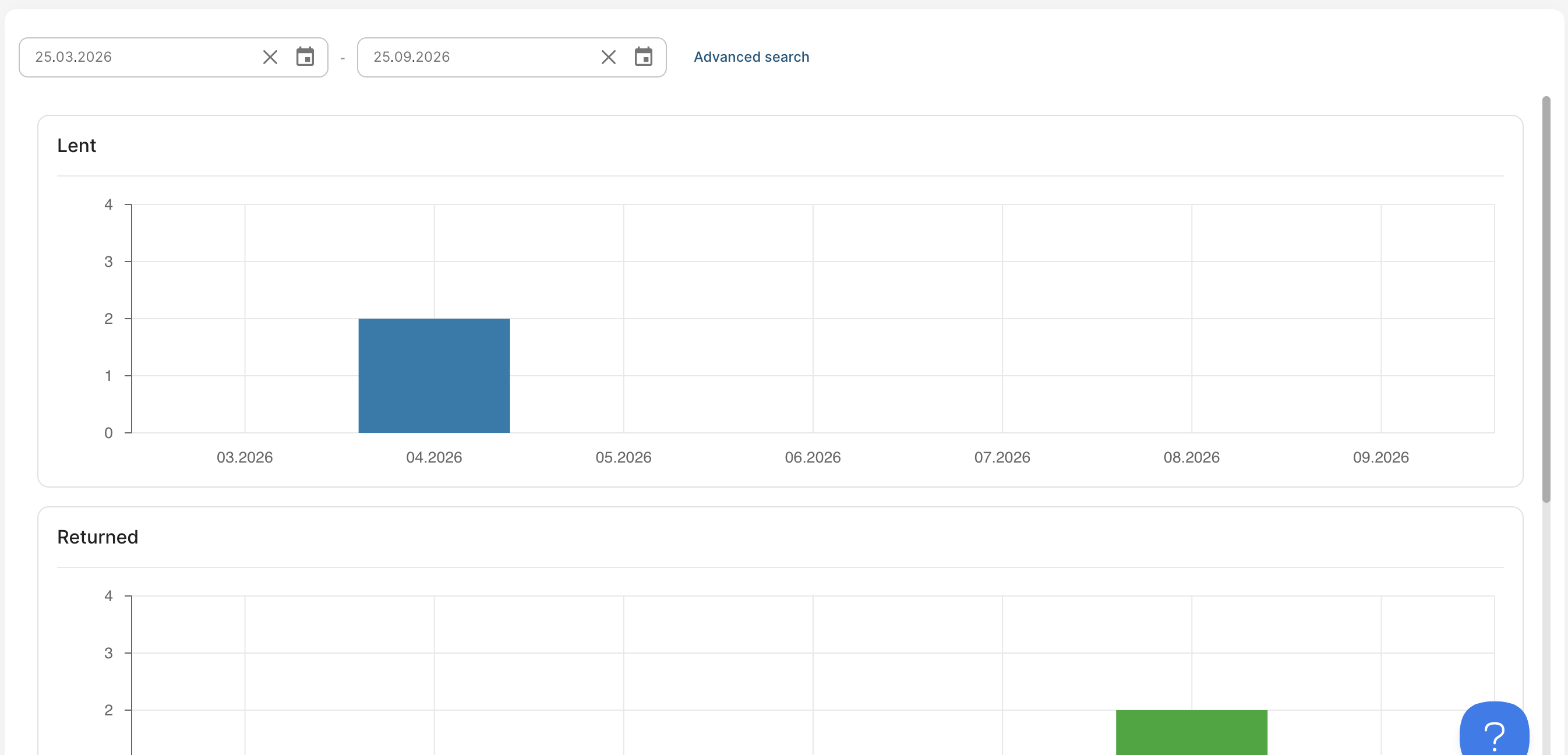
The Lendings report provides an overview of item activity related to lendings.
The report shows as a bar chart:
- number of items lent
- number of items returned
- number of items deleted as part of a lending
You can filter the report by date, category, and location. For example, you can use the filters to review lending activity for a specific category during a selected period.
Storage status
The Storage status report allows you to review the contents and available capacity of storage locations.
The report shows the number of:
- child locations
- items
- set pieces
- costume sets
belonging to each location.
The report also shows the occupancy rate as both a percentage and a quantity.
Click the name of a parent location to view its child locations and their information in more detail.
Occupancy rate
The occupancy rate helps you see how many storage locations, such as warehouse shelf spaces, are occupied and how many are still available.
When an item, such as a storage wagon, pallet, or rack, is added to a child location, that storage space is considered occupied. If the child location does not contain an item, it can be shown as available.
For the occupancy calculation to work correctly, all child locations that should be included in the calculation must have their location type set to Storage.
If a child location has another location type, it is not handled in the same way in the occupancy calculation and is shown as available.

Other reports and downloadable data
In addition to the Reports module, different Trail modules provide their own reporting and export options.
Depending on the module, you can export information such as:
- item lists
- defect reports and their details
- reservation information
These reports and exports can be useful when you want to review or process Trail data outside the system.